
Brendan Greene Defends Human Artistry in Prologue Go Wayback
Prologue Go Wayback, by Brendan Greene, redefines survival games with machine-learning-driven worlds and a bold stance on generative AI.
In the shifting landscape of survival games, few names carry the mythic weight of Brendan Greene, the mind behind the genre-defining battle royale phenomenon PUBG. Now, through his independent studio PlayerUnknown Productions, Greene has spent the past years sculpting a new vision: Prologue Go Wayback, a survival experience that trades shrinking circles for emergent, machine-learning-driven worlds. Since entering early access in November 2025, the game has drawn attention not only for its punishing environments but also for its creator's fiercely uncompromising stance on generative AI—a position that sets him apart from the industry trend embodied by his former publisher, Krafton.
Prologue Go Wayback is the opening chapter of a planned trilogy, a project that Greene describes as his chance to push scale and systemic storytelling beyond what static handcrafted spaces can achieve. From the earliest footage, the game paints a wilderness teeming with danger: dynamic weather systems that bury paths in snow, forests that thicken into mazes, and a landscape that reshapes itself each time a player starts fresh. The goal is simple, escape a hostile backcountry, but the journey is governed by a web of interconnected survival mechanics. Hunger, exposure, fatigue, and injury all operate on unforgiving timers, forcing players to scavenge, craft, and navigate with constant dread.
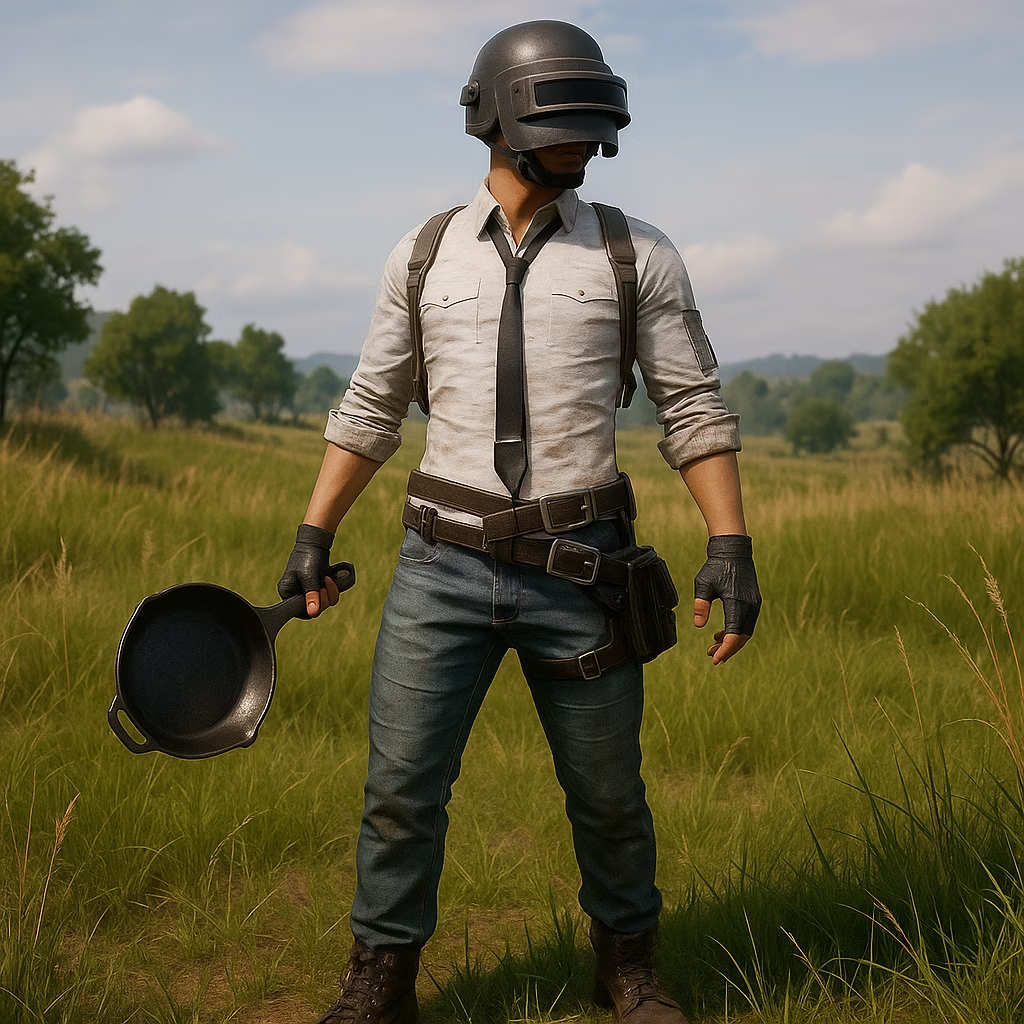
What truly separates Prologue from its peers, however, is the way it builds its world. Rather than leaning on hand-sculpted maps, PlayerUnknown Productions employs machine learning systems that act as a “conductor,” in Greene’s own words. Artists and designers set the rules, establish boundaries, and create the raw assets—trees, rock formations, abandoned structures—while the machine orchestrates them into vast, unpredictable terrain. This is not the controversial generative AI that scrapes data without permission, but an elegant toolset that multiplies human creativity without replacing it.
In interviews, Greene has drawn a bright line between his approach and the large language models flooding the tech world. He remains openly dismissive of chatbots and LLMs, noting that similar experiments already existed in the 1960s and 1970s. “I’ve been really heartened to see the community revolt against AI stuff,” he remarked in a 2025 Eurogamer conversation, his words echoing a growing player sentiment. “It’s good to see that gamers go: ‘No—if it’s not built by artists, I don’t want to see it.’” That grassroots defiance gave him confidence that his studio’s direction would resonate.
The tension became especially visible when Krafton, the Korean conglomerate that owns PUBG and retains a minority stake in PlayerUnknown Productions, announced an AI-first policy. The company offered voluntary redundancies and signaled a future where development pipelines would lean heavily on automated content creation. Greene responded by clarifying the independence of his outfit, stressing in a follow-up email that “our overall goals at PlayerUnknown Productions are not influenced by Krafton’s chosen strategy.” He underscored that since 2021, the two entities have operated separately, a firewall that allows his team to favor artistic integrity over cost-cutting algorithms.
Despite the philosophical clash, Greene’s machine learning pipeline still requires an immense amount of human craft. Procedural generation is often misunderstood as a button-press that spits out a world, but the reality inside PlayerUnknown Productions is messier and more collaborative. Concept artists painstakingly model every asset variant, level designers script encounter zones and resource distributions, and narrative designers weave subtle breadcrumb trails through the chaos. The machine merely arranges these pieces with constraints that the team has tuned over countless iterations. As Greene puts it, his system gives creators “some levers you can pull,” turning world-building from a violin solo into a symphony conducted with care.
Since its early access launch, Prologue Go Wayback has become a testing ground for this philosophy. Early adopters have shared stories of dying to hypothermia because they misjudged river currents, or stumbling into caves that weren’t there in a previous run. That unpredictability, born from the combination of artist-crafted ingredients and algorithmic assembly, fuels the tension that Greene chased during his PUBG days. But now, instead of a shrinking circle forcing conflict, it is the land itself that becomes the adversary.
Community feedback has already shaped the cadence of updates outlined in the November 2025 roadmap. Spring 2026 saw the introduction of dynamic shelter degradation, making every campfire and lean-to a temporary reprieve. Summer brought expanded cooking mechanics and wound infection systems, layering long-term consequences on every failed hunt or clumsy climb. Autumn promises a complete faction rework, introducing wandering NPCs whose behavior is guided by the same machine learning that crafts the terrain—people, Greene hints, who remember your choices.
Throughout this evolving development cycle, Greene has remained adamant that no artist will lose their job to a prompt. “Our focus is on using technology to solve problems of scale for players to enjoy bigger and more emergent worlds,” he insists. That promise, in an era where studio layoffs routinely accompany AI rollouts, stands as a quiet counterweight. It suggests that scale and ambition need not come at the cost of the very people who bring a game’s soul to life.
As the second half of 2026 unfolds, PlayerUnknown Productions is demonstrating that a survival game can be technologically ambitious without sacrificing human artistry. The studio’s stance arrives at a moment when the industry is grappling with what authenticity even means, and Greene’s wager—that players will reward worlds built by hands and hearts, not scraped by scrapers—has so far found a receptive audience. Prologue Go Wayback is harsh, unpredictable, and deeply personal, qualities no machine could fabricate alone. And that, perhaps, is exactly the point.