
Brendan Greene's Prologue Journey Beyond PUBG Realms
Discover Brendan Greene's innovative Prologue, blending neural networks and AI-generated wilderness to revolutionize survival gaming with boundless discovery.
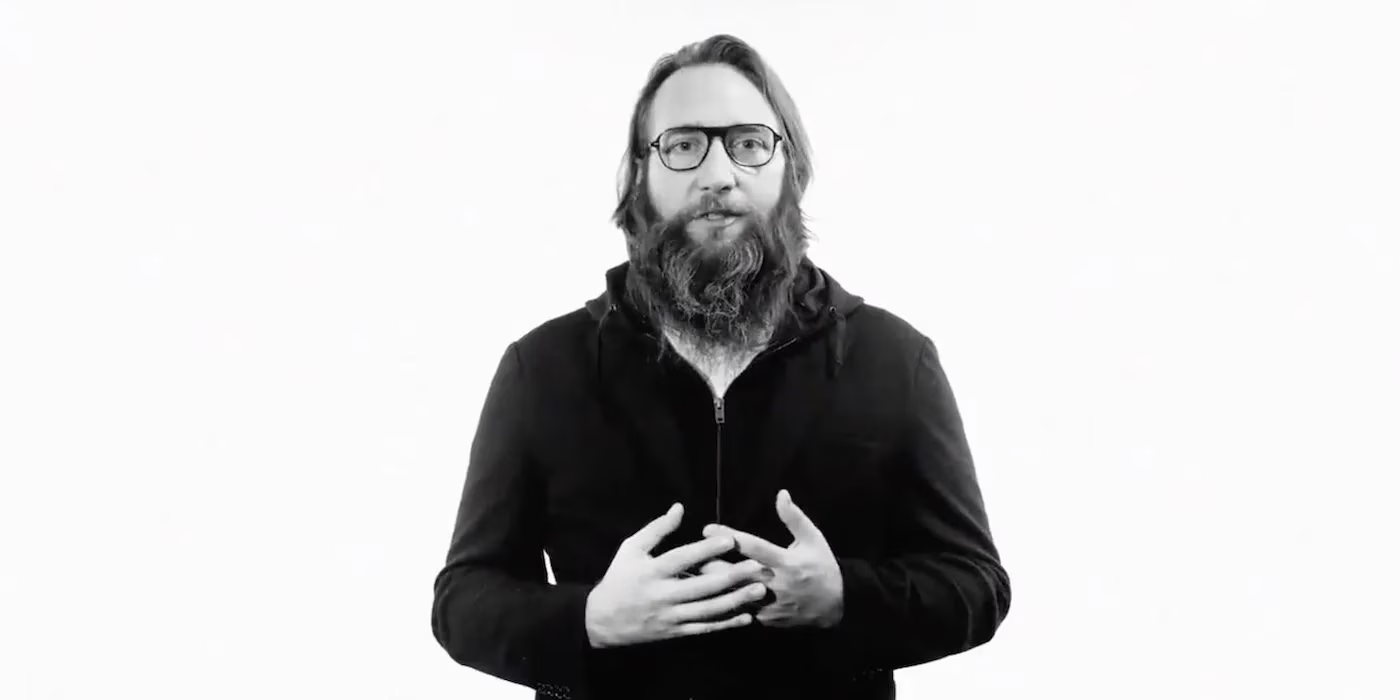
You remember Brendan Greene, right? The architect behind that global battle royale tsunami called PUBG? Well, back in 2021, he made waves again by stepping away from Krafton's towering fortress. Not with a whimper, but with the thunderous declaration of PlayerUnknown Productions – his own creative sanctuary. And at its heart? A mysterious entity codenamed Prologue. This wasn't just another game announcement; it felt like a manifesto. Greene wasn't just changing studios; he was fundamentally shifting his design philosophy from structured chaos to boundless discovery. While PUBG's legacy still echoes in every shrinking arena shooter today, Greene's gaze had already drifted toward horizons most developers wouldn't dare explore. 🌍
From Battle Royale Architect to Digital Cartographer
Let's rewind that tape. Before PUBG became a billion-dollar behemoth, Greene was tinkering in the Arma modding trenches. That's where the magic started – blending survival's desperate scavenging with last-man-standing tension. Funny how that little experiment birthed an entire genre, with titans like Fortnite and Apex Legends joining the fray. But here's the twist: while others perfected his blueprint, Greene grew restless. He'd often muse about "realistic sandbox worlds on a scale that’s seldom attempted." Translation? He wanted to build planets, not playgrounds. Prologue, first teased at 2019's Game Awards, became his vehicle for that cosmic ambition. It marked his deliberate exit from the battle royale coliseum he'd constructed.
Neural Networks & Uncharted Wilderness: The Tech Frontier
So what's under Prologue's hood? Greene's team is betting big on machine learning – specifically, a neural network system that dynamically builds worlds. Imagine this: you get dropped into a wilderness that wasn't pre-scripted by designers, but birthed in real-time by algorithms. Every mountain range, river bend, and storm system emerges uniquely for each journey. No quest markers. No tutorials. Just raw, untamed geography daring you to survive. Greene described it as creating "rich, interactive worlds" where players truly write their own narratives. Tools? Resources? You'll scavenge them like a digital pioneer facing nature's indifference. It's survival gaming stripped to its primal core:
| Traditional Survival Games | Prologue's Approach |
|---|---|
| Hand-crafted maps | AI-generated wilderness |
| Guided progression systems | Emergent, player-driven discovery |
| Predictable ecosystems | Reactive environments via neural nets |
Revolutionizing Value: The Pay-What-You-Want Gambit
Here's where it gets fascinating. Amidst an industry obsessed with battle passes and microtransactions, Greene proposed something radical: pay what you want. "If you like what you see," he tweeted, support the team – but no pressure. This wasn't just business model innovation; it felt like a philosophical stance. Almost as if he was saying, "Judge the world we've built, then decide its worth." A bold move for a project banking on unprecedented technological scale. Could this become a blueprint for indie studios tackling AAA-sized dreams? Time will tell.
The Silence Before the Storm (2025 Update)
Now, four years after that initial reveal, the gaming sphere still buzzes about Prologue. Concrete details? Still scarce as hen's teeth. But Greene's vision – those "massive worlds" and "extensive player experiences" – lingers like campfire smoke in the collective imagination. While PUBG continues evolving with new maps and modes, Greene's journey feels different. He's not iterating; he's inventing. That neural network promise? If realized, it could redraw boundaries between game design and artificial intelligence. No pressure, Brendan. 😉
So here we stand in 2025, watching the horizon. Brendan Greene began with mods, conquered the world with battle royale, and now? He's chasing digital frontiers where survival meets singularity. Prologue might just be the opening chapter to gaming's next great wilderness – and honestly? We're all still leaning in, waiting to hear that first sentence.