
The Battle Royale Evolution: From PUBG and Fortnite to 2026's Esports Giants
Battle royale esports, led by PUBG and Fortnite, have reshaped competitive gaming with massive prize pools and global fan engagement.
The global esports landscape has undergone a seismic transformation over the past decade, with competitive gaming now generating prize pools that rival traditional professional sports. At the heart of this revolution lies the battle royale genre – a format that parachutes 100 players onto a shrinking map in a frantic fight for survival. What began as a niche modding experiment has mushroomed into a multi-billion-dollar industry, captivating hundreds of millions of viewers and turning talented gamers into household names. By 2026, the scene looks radically different from the early days of PlayerUnknown's Battlegrounds, yet the addictive thrill of that "Winner Winner Chicken Dinner" moment remains the beating heart of the phenomenon.
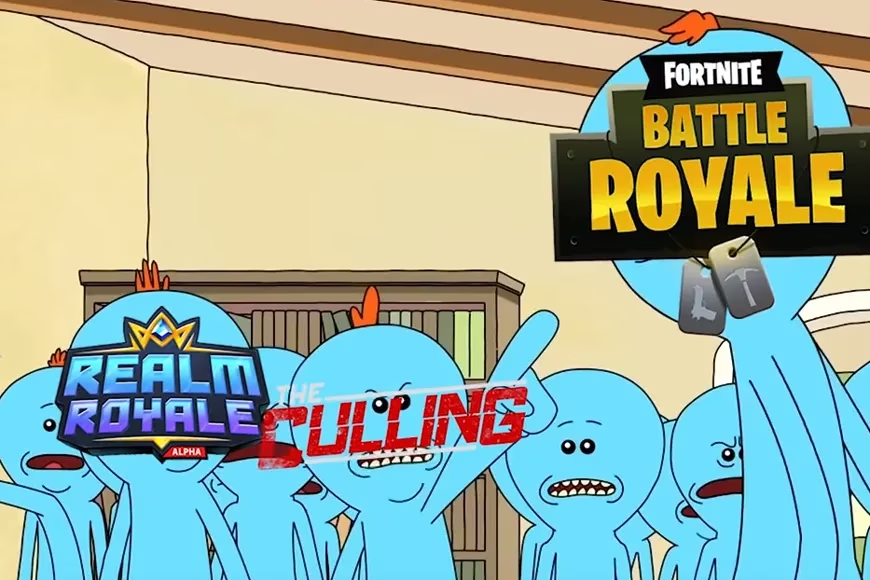
The Trailblazers: PUBG and the Fortnite Frenzy
When PUBG (PlayerUnknown's Battlegrounds) burst out of beta in 2018, it did more than popularise a genre – it rewired the competitive gaming ecosystem. The concept was brutally simple: 100 players, three sprawling maps, and a single winner per round. Tournaments began cropping up worldwide, but logistical nightmares haunted early LAN events. Organising a live final required 100 synchronised machines under one roof, a challenge that forced tournament operators to invent entirely new broadcast and server architectures. The 2018 PUBG Global Invitational in Berlin, with its $2 million prize pool, proved the concept could work at scale, yet persistent accusations of cheating and hacking threatened to derail the momentum. Developers struggled to clamp down on rulebreakers, but the community remained fiercely loyal.
Meanwhile, Fortnite exploded onto the scene with a completely different flavour. Where PUBG leaned into gritty realism, Epic Games' creation embraced vibrant, cartoony aesthetics and an evolving narrative tied to seasonal events. The player base rocketed to 125 million active users, and the spectacle of virtual concerts and in-game movie premieres blurred the line between game and social platform. However, Fortnite's first foray into high-stakes esports during the summer of 2018 was marred by server crashes and a defensive meta that drained the excitement. Many questioned whether the title could ever transition from casual phenomenon to serious esports contender. The answer arrived spectacularly at the 2019 Fortnite World Cup, where a solo final awarded $3 million to the winner and the total prize pool exceeded $30 million – a figure that single-handedly reset expectations for what battle royale esports could achieve.
The Contenders That Chased the Crown
As PUBG and Fortnite demonstrated the genre's immense potential, a flood of developers scrambled to claim their share. The reference class of 2018–2019 included several triple-A franchises and ambitious indie projects, each bringing unique twists to the last-man-standing formula.
-
🎯 Call of Duty: Black Ops 4 – Blackout – Treyarch’s entry brought the franchise’s signature gunplay to a massive map, and early streamer reactions were overwhelmingly positive. Blackout proved that a polished, triple-A battle royale could compete, but it was eventually overshadowed by the free-to-play juggernaut Call of Duty: Warzone released in 2020, which would go on to define the series’ esports presence throughout the mid-2020s.
-
🛡️ Battlefield V – Firestorm – DICE’s attempt to marry its trademark large-scale warfare with survival mechanics generated buzz, but a late launch and lack of post-release support caused Firestorm to fizzle out almost as quickly as it arrived. The mode is now studied as a cautionary tale about brand dilution in a saturated market.
-
⚒️ Darwin Project – This ten-player survival title introduced a unique show-director mechanic, where a spectator could influence the match in real time. Though critically praised for innovation, it never built the critical mass needed to sustain a competitive scene.
-
⚔️ Realm Royale – Hi-Rez Studios’ class-based fantasy take briefly captured attention, but balance issues and shifting developer priorities led to a steep decline in player numbers by 2020.
-
💀 H1Z1 – One of the earliest battle royale titles (originally "King of the Kill"), H1Z1 struggled to keep pace with its younger, more polished rivals and eventually transitioned into a niche legacy product.
2026: The State of Battle Royale Esports
Fast-forward to 2026, and the battle royale genre has not only survived the initial gold rush but matured into a layered ecosystem with distinct sub-genres and year-round competitive circuits. The early logistical hurdles of 100-player LAN events have been overcome through cloud-based server infrastructure and hybrid broadcast models that mix in-person stages with remote competitors.
Epic Games now operates a permanent Fortnite Championship Series with seasonal point structures and a cumulative prize fund that regularly exceeds $50 million annually. The early defensive meta has long since been replaced by an aggressive, mobility-heavy meta featuring vehicles, grappling tools, and dynamic weather that keeps every circle tense. Fortnite’s cross-media integration – guest appearances from Hollywood flms, music icons, and even historical figures – means its esports broadcasts attract a diverse audience far beyond traditional gaming demographics.
PUBG, after a quiet period of competitive restructuring, returned to the forefront in 2024 with PUBG 2.0, a rebuilt engine that eliminated cheating vectors and introduced native anti-cheat AI systems. The PUBG Global Championship 2026, held in Seoul, boasted a $12 million prize pool and broke viewership records with 85 million unique online viewers – nearly double the number that tuned into the first Global Invitational. The “Chicken Dinner” slogan has become a staple of internet culture, recognised even by those who have never picked up a controller.
Meanwhile, the landscape is far from a duopoly. Apex Legends, released in 2019, has steadily climbed into the top tier, leveraging hero-shooter mechanics and a lightning-fast pace. Its ALGS (Apex Legends Global Series) now commands a loyal fanbase and routinely fills arenas. The Call of Duty League adopted Warzone as a permanent third mode alongside traditional multiplayer and Search & Destroy, and the $10 million Warzone World Championship 2025 set new benchmarks for first-person battle royale viewership. Newcomers such as Off the Grid, a cyberpunk-themed extraction royale with blockchain-backed skins, have further diversified the genre, proving that innovation still has a place in a crowded market.
Why It Matters
Esports as a whole generated a collective prize pool exceeding $113 million in 2017; by 2026, annual prize money across all titles comfortably surpasses $400 million. The battle royale segment accounts for roughly 35% of that total, a staggering figure considering the genre barely existed a decade ago. The 2017 Intel Extreme Masters in Katowice set a then-record attendance of 173,000; in 2025, the combined live audience for season finales of Fortnite, PUBG, and Apex Legends topped 500,000. These are numbers that put esports on par with the Super Bowl and UEFA Champions League finals, not just in viewership but in cultural impact.
From casual flossing to professional careers that include salaries, sponsorship deals, and retirement plans, battle royale games have completed an extraordinary journey. The early controversies – cheating, server instability, defensive gameplay – have been systematically addressed by developers who recognised that competitive integrity is the fuel of long-term success. As 2026 races toward its midpoint, the question is no longer whether battle royale is a legitimate esport, but rather which title will be the next to capture the world’s imagination and deliver that next generation of digital champions.